PRESS RELEASE

Blumorpho and AIVP Beyond Public Funds:
New Strategies Mobilizing Private Capital for City-Port Innovation
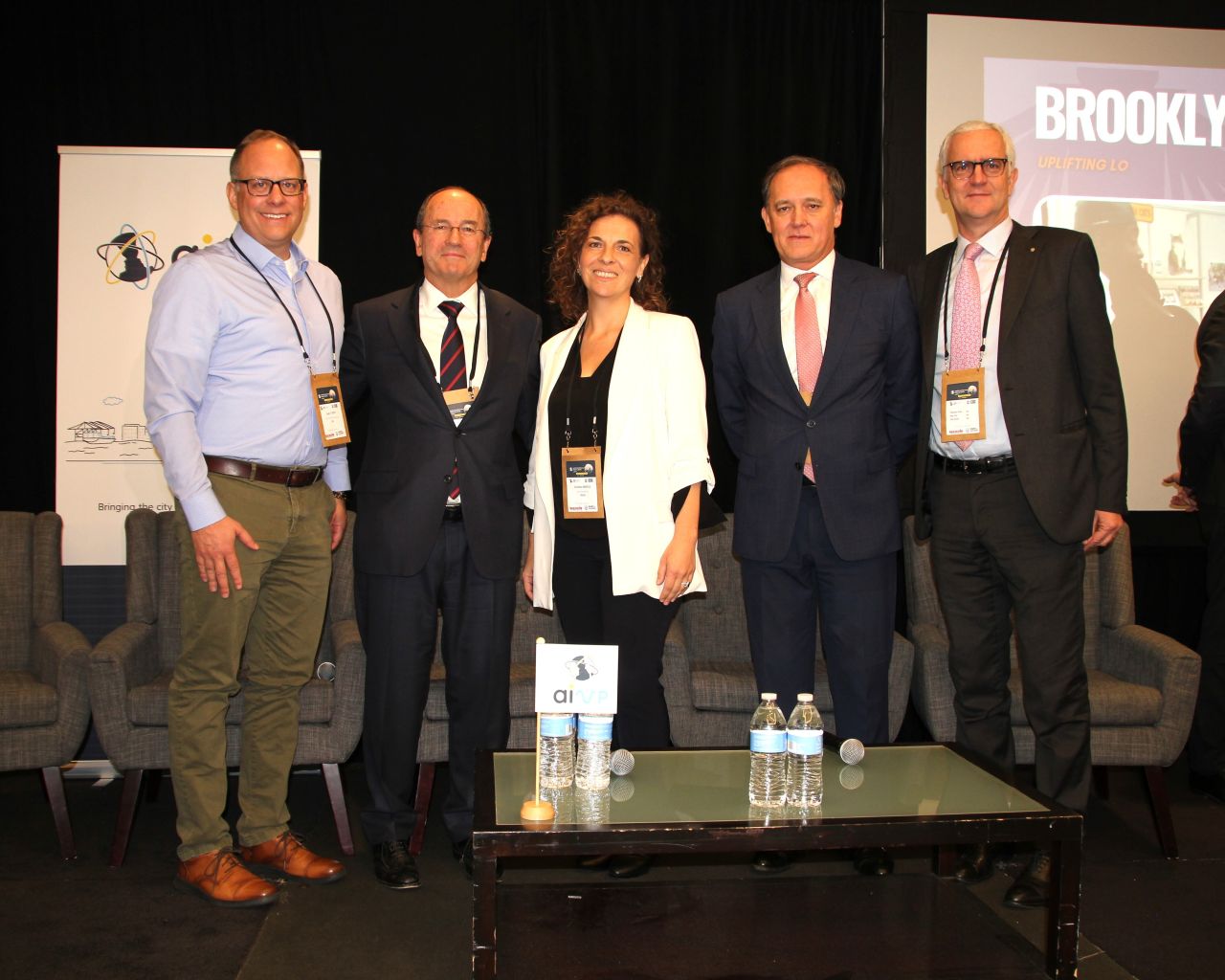
New York, November 21, 2025 – In November 2025, the International Association of Cities & Ports (AIVP) successfully concluded its 20th World Conference Cities & Ports in New York, co-hosted with the New York City Economic Development Corporation (NYCEDC). Under the theme “Navigating Change: Innovating Ports, Cities and Climate,” the conference brought together city and port stakeholders, financial institutions, and more, to discuss the urgent need for financing the transition of city-port ecosystems.
Blumorpho was invited to host one of the panel discussions: “Financing the City–Port Ecosystem: New Approaches, New Challenges”. Géraldine Andrieux, President of Blumorpho, was conducting a discussion with leaders from diverse sectors: Alberto Cappato (Municipality of Genoa), Jason Giffen (Port of San Diego), Jérôme de Bontin (Capricorn Investment Group), and Rafal Rybacki (European Investment Bank).
The conversation was not only rich on stage, it was also interactive, with the audience contributing through a live survey. Nearly a hundred respondents participated, shaping the panel’s message.
This dialogue was part of the broader Financing Maritime Innovation and Infrastructure for Climate and Ocean initiative, launched earlier this year in Monaco by Blumorpho with the AIVP and the support of the Prince Albert II of Monaco Foundation. Financing Maritime Innovation and Infrastructure for Climate and Ocean brings together ports, cities, investors, corporates, and startups to co-develop scalable, bankable solutions for climate adaptation, decarbonization, and ocean resilience.
As a boutique innovation strategy firm and innovation program designer and operating partner, Blumorpho positions itself at the intersection of market opportunities, innovation, and finance. The company designs collaborative programs that generate value, structure investment-ready opportunities, and accelerate impactful solutions across ecosystems. Through initiatives like Financing Maritime Innovation and Infrastructure for Climate and Ocean, Blumorpho brings together public actors, financial institutions, corporates, and innovative companies to shape investable pathways for resilient port-city and maritime infrastructure.
Aligning Innovation, Public Investment, and Private Capital
Alberto Cappato, who recently took the position as Director of Mobility at the Municipality of Genoa (previously Head of Innovation and Sustainability at Porto Antico di Genova), set the tone by highlighting the strategic challenge: bridging the gap between long-term vision and short-term demands. He added that, based on his recent engagement during the Financing Maritime Innovation day preceding the UN Ocean Conference (UNOC), where investor expectations and port city project maturity were discussed in detail, the focus needs to shift.
“Too often, public money builds infrastructure that isn’t used because the services aren’t in place. We should focus on creating the right conditions to attract and enable private investment. That’s how we’ll stay competitive and deliver lasting impact.”
Alberto stressed this by citing the Genoa quay electrification project: “We electrified a 400-meter quay, despite the board’s initial reluctance. Pollution disappeared, noise stopped, restaurants thrived, and mega yachts stayed longer. Eventually, the board realized the return wasn’t only financial: it was in quality of life and business vitality.”
This principle of smart investments creating systemic benefits resonated throughout the panel, framing a key question: how can ports and cities catalyze innovation while making projects financially attractive?
Audience Priorities: Where Port Cities Need Investment
The discussion on strategic investment areas was immediately validated by audience polling. When asked about the most relevant investment opportunity for their port city, delegates were largely focused on climate preparedness.
This clear focus on Climate Resilience (44.1% of respondents) reinforced the urgency of finding financial solutions for adaptation, a theme later addressed by the EIB and the Port of San Diego. It is followed by a strong focus on renewable energy & alternative fuels (23.5%), and waterfront regeneration & tourism (17.6%).
Insights from the Port of San Diego
Jason Giffen, Chief Sustainability & Innovation Officer at the Port of San Diego, shared practical examples of how a port can be a “living laboratory” and an early-stage investor.
“We set aside money every year to invest in what’s called a Maritime Industrial Impact Fund. We invest in things like bikeways, urban greening, and electrification in neighboring port communities.”
Jason detailed how the Port leverages its position to de-risk innovation through piloting projects. He introduced the audience to the Port’s Blue Economy Incubator (BEI), supporting native industries such as Aquaculture, but also Nature Based Solutions, Coastal Resiliency and Ocean Monitoring, Maritime Decarbonization, and more.
Jason reinforced the importance of the ecosystem approach to value positive externalities of investment, noting the importance of mechanisms like the California Low Carbon Fuel Standard (LCFS), which allows the Port to generate credits by monetizing the reduced carbon intensity of electric shore power usage.
“The LCFS allows us to monetize emissions reductions when vessels use electric shore power instead of diesel at berth. We can also extend this framework to our tenants and cargo handling operations, creating a market for clean energy credits.”
Finally, he emphasized the need for ports to act as “living laboratories”: “Ports are often perceived as conservative or risk-averse, but that perception overlooks the reality of our role. We are on the front lines, forced to innovate constantly: whether adapting to extreme climate events, to geopolitical changes, or to massive economic shifts. Because we must adapt all the time, ports actually play an essential, catalytic role in driving innovation across the entire supply chain.”
The Investor Perspective
Jérôme de Bontin, Partner at Capricorn Investment Group, provided the critical equity perspective, emphasizing patient capital and deep technological expertise. Capricorn focuses on transformative industries, having been an early investor in Tesla and companies that require modern, green port infrastructure, like battery recycler Redwood Materials, or Electra developing an electrochemical iron ore reduction technology, a new approach to decarbonize steel production.
“We could take risks where others would not. So, we were the definition of investors with patient capital. We will invest between 20 and 100 million in a new company.”
He then reiterated the main barrier: “The question is not about access to capital. The question is to get a good project, in terms of profitability, in terms of climate.” There is a need for clear, credible projects. And in this approach, the more we can reduce risk through partnerships between cities, ports, and innovators, the more capital we can mobilize.
The Debt Perspective: A Systemic Approach to Ports and Cities
Rafal Rybacki, European Investment Bank Representative to the United Nations, outlined the EIB’s perspective as a large development institution focused on debt financing (up to €100 billion annual lending planned for 2025).
Rafal emphasized the EIB’s integrated approach, where projects are assessed against the broader Blue Economy and the port’s cohabitation with the city. “We very much support the integrated nature of the project. We will always assess this particular piece of assets in correlation with other elements of the ecosystem around this asset.”
He advised stakeholders to demonstrate integration with the city, broad economic benefits (externalities) beyond financial returns, and a clear long-term vision for the up to 20–25-year loans the EIB typically provides to finance this type of asset.
“The ultimate picture of the project that you come with to the EIB or any other bank has to be clear. There should be clear division of risk, of clarity, who is taking what risk.”
This echoes Financing Maritime Innovation and Infrastructure for Climate and Ocean’s objective: helping port cities prepare structured, investable, long-term transformation strategies.
Audience Feedback: Identifying Financing Barriers
The audience poll on the main barriers to financing strongly supported the panel’s focus on complexity and structure, rather than a lack of good ideas.
The results show that while Access to Capital (38.9%) remains the primary concern, Governance Complexity (33.3%) is a nearly equal barrier, reinforcing the EIB’s emphasis on clarity and the Blumorpho initiative’s goal of project structuring.
Key Takeaways: Connecting Equity and Debt
The panel concluded by synthesizing the complementary roles of the participants – equity (Capricorn), debt (EIB), and port cities – in bridging the financing gap.
When asked about the most important support they would seek in joining the Blumorpho/AIVP/Prince Albert II Foundation initiative, the audience response was definitive.
With 52.2% of the votes, supporting long-term vision was the overwhelming priority, connecting directly with the core message from all panelists: that long-term commitment and strategic clarity are necessary to overcome short-term economic pressures. This reinforces Financing Maritime Innovation and Infrastructure for Climate and Ocean’s focus on long-term strategic alignment and project readiness. The lower score for Access to private investment (8.7%) confirms Jérôme de Bontin’s point that capital is available, but the projects need to be structured to attract it.
Conclusion: From Dialogue to Action
The Financing Maritime Innovation and Infrastructure for Climate and Ocean initiative, driven by Blumorpho, in partnership with AIVP, and with the support of the Prince Albert II of Monaco Foundation, continues to build a pipeline of investable projects, combining city-port innovation with climate resilience strategies. The conversation in New York demonstrated that progress is possible when expertise, finance, and innovation converge.
The conference, rich with global case studies on climate adaptation, coastal resilience, and digital innovation, provided the perfect platform to emphasize this urgency. New York, through NYCEDC’s “Harbor of the Future” initiatives, served as a powerful “living case study” for sustainable port-city innovation. Our panel directly addressed the need for new approaches to funding these transformative global efforts.
The dialogue highlighted that finance models, leveraging public funds to de-risk and catalyze private investment, are essential for transitioning city-port assets at the necessary scale and pace.
The session closed on a positive and actionable note: the live word cloud captured the overall sentiment of the room as “Optimistic,” “Informative,” and “Motivated” being highly prominent. The challenges of governance and capital access yielded to a sense of encouragement. As Jason Giffen concluded: “I think my conclusion was to be encouraged. It’s groups like AIVP that can bring together port cities and investors. And I think this is where we need to be.”
Moving forward, the Financing Maritime Innovation and Infrastructure for Climate and Ocean initiative will focus on creating a concrete, investable project pipeline. We will leverage the expertise of private equity and debt providers to refine the governance and financial structures, allowing finance models to successfully de-risk critical investments in climate resilience and innovation. Our goal is to support port cities to thriving engines of sustainable economic growth. We look forward to continuing this work over the next few months and at the 2026 AIVP World Conference in Dunkirk.
About BLUMORPHO
BLUMORPHO is a boutique innovation strategy firm and ecosystem-driven platform dedicated to accelerating the deployment of impactful solutions and projects. Positioned at the intersection of complex markets and high-growth opportunities, BLUMORPHO bridges emerging innovations, market needs, and financing pathways. The company designs and operates innovation programs and events to unlock untapped value, enable adoption at scale, and structure investment-ready projects in collaboration with strategic financial partners.

About AIVP
The International Association of Port Cities (AIVP) is the leading global network promoting sustainable port city development. Founded over 35 years ago by major European port cities, AIVP brings together nearly 200 members in 45 countries, from local governments and port authorities to businesses. Through its Agenda 2030, AIVP supports integrated strategies that align climate action, biodiversity, mobility, and social inclusion, positioning port cities as key players in the global transition.