PRESS RELEASE
Chips Venture Forum 2025 Panel :
End-Users Market for Semiconductors
How Europe Can Become a Strong End-Users Market for Semiconductors
Insights from the Chips Venture Forum 2025 in the scope of the aCCCess project
Europe holds globally recognised strengths in semiconductor equipment, materials, design, photonics and quantum. Yet despite this excellence, the continent’s limited end-users market and fragmented industrial pathways continue to restrict scale-up potential compared to the US and Asia.
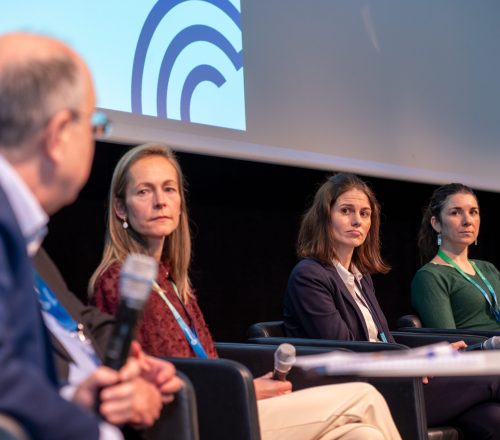
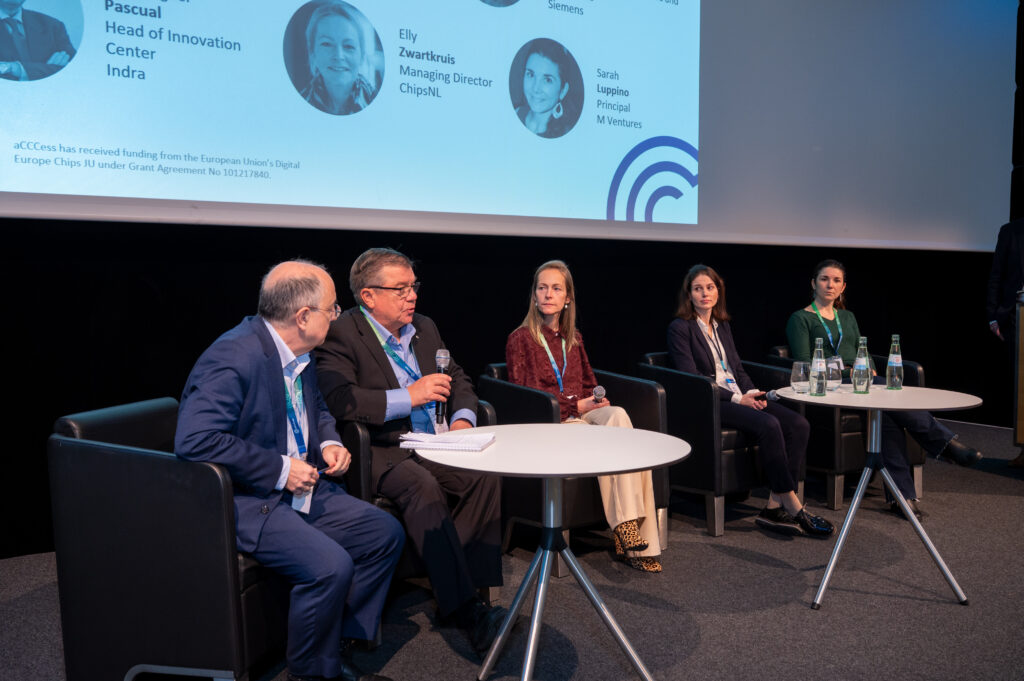
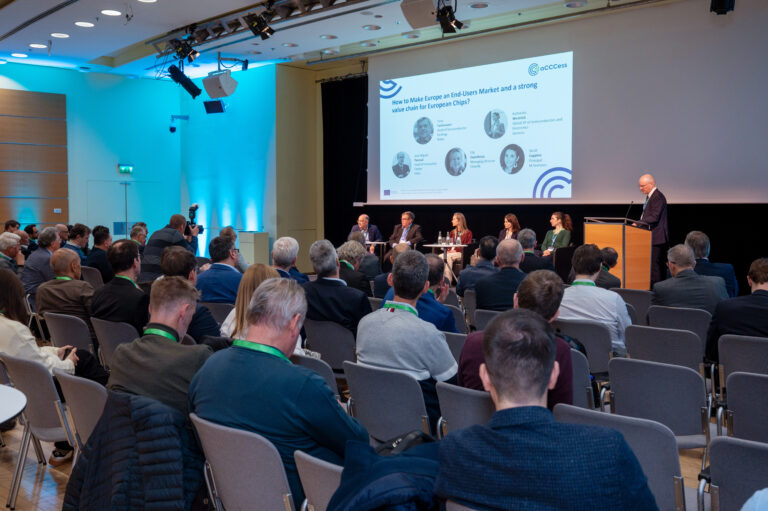
This challenge, central to the ambition of the Chips Act and the aCCCess initiative, was the focus of the panel “How to Make Europe an End-Users Market and a Strong Value Chain for European Chips”, moderated by Régis Hamelin, CTO of Blumorpho, and coordinator of the aCCCess project, during the Chips Venture Forum 2025.
The discussion brought together corporate leaders, investors and competence centers to explore how Europe can align innovation, industrial capacity and demand to strengthen sovereignty and competitiveness.
Europe’s Strengths and Structural Gaps in the Semiconductor Value Chain
Europe excels in:
- semiconductor equipment and materials,
- advanced design,
- photonics and quantum,
- world-leading R&D ecosystems,
- strong engineering talent.
However, panelists highlighted persistent gaps:
- Fragmentation between innovation and market adoption : Europe produces strong technology but struggles to translate it into scaled products validated by European end-users.
- Industrial bottlenecks manufacturing and packaging photonics :
As noted by Elly Zwartkruis (ChipNL Competence Centre):
- Photonics pilot lines exist, and dedicated foundries are being established and scaling support in chip design.
- but we see a need for Europe to enhance efforts in heterogeneous integration and scalable photonics packaging innovations, as this is limiting scale-up and adoption.
Elly mentioned that, up to now, three main requests have emerged from customers:
- access to capital,
- support in funding the first launching customer to co-develop a real solution, and
- The funding valley of deathremainsacute
Funding is available up to ~€10M, but:
- beyond 10M, options become scarce,
- late-stage capital (Series B/C) is highly limited.
This is one of the most critical recommendations for Chips Act II.
Corporate Investor Perspective: Faster Validation Is Key to European Scale-Up
From the perspective of Sarah Luppino (M Ventures – Merck Group), venture capitalist see the gravitational pull of the US market as structural:
- US validation cycles are faster,
- tier-1 fabs remain the global reference point,
- hence startups naturally prioritise the larger and quicker markets.
Her message was clear:
“If Europe wants startups to scale here, Europe would need to develop a stronger local end market that bring venture-sized returns.”
Lessons from Japan: Coordinated National Strategy Matters
Returning to a global perspective, Sarah Luppino used the success of Japan’s Rapidus initiative as an example.
Key lessons for Europe:
- strong alignment between government, industry and capital,
- long-term commitments,
- rapid industrial mobilisation.
Her implicit message:
Europe could consider replicating this level of coherence and strategic continuity to build a more competitive semiconductor ecosystem that is compelling enough to entice startups to scale within the region.
End-User Viewpoint: Balancing Sovereignty and Competitiveness
From an end-user perspective, Timo Tenhovuori (Nokia) highlighted fundamental trade-offs impacting European industrial adoption:
- Supply chains are fragile, chips makeprocess is often still executed in many countries and many process steps are completed in Asia.
- Sovereignty is important but price competitiveness remains important purchase decision factor
- European companies must secure both advanced and mature nodes design skills and availability
- More chiplet IP, RF circuits, MEMS, sensors and power electronics should originate from Europe.
Timo also mentioned the importance of Connectivity Microelectronics, which Nokia designed in the EU for 5G and 6G mobile networks.
It supports several key EU goals:
- EU-based critical systems that rank among the global top three digital products in their sector
- Highly advanced chip design using <3 nm technology
His key insight:
“Sovereignty matters but if a component is significantly more expensive, customers will be hesitating adopting it.”
Europe must therefore combine sovereignty with competitiveness.
Building Europe’s Industrial Foundations: Packaging, Prototyping and Talent
José Miguel Pascual (Indra) highlighted that sovereignty is not only political, it is industrial. Today even there are areas in which Europe is leading there is a lack of capabilities on a number of critical technologies that are not comparable to the level on other regions. High Power and Integrated Radiofrequency, Mixed signal, and programmable logic/processing are clear examples.
This is particularly clear in Defence and the Dual Use of these technologies can allow synergies on balance volumes and access to talent, capability and capacity.
Key priorities include:
- Strengthening the full ecosystem
From talents to research, prototyping, industrialisation and production, all must be aligned. aligned. The focus should be to develop innovative products by using innovative semiconductors and also increase the speed and use of the existing and future capabilities.
- Securing access to nodes
Access to mature nodes in Europe is good but vulnerable to global price competition. Not only the future or advanced nodes are important also to assure and make more accessible the mature nodes.
- Industrial packaging and interconnection
As he stressed:
“Everything will go through advanced packaging in the future.”
- Flexible and affordable access to design and prototyping tools
Europractice-like models should be scaled with an explicit industrial focus, not only research.
The Role of European System Integrators in Creating Domestic Demand
Katharina Westrich (Siemens) reminded the audience that Siemens plays a dual role in Europe:
- major end-user,
- Europe’s leading EDA provider.
Her key recommendations:
- A balanced node strategy
Europe must invest in both advanced and mature nodes.
- Sovereignty through designto manufacturing
Katharina highlighted the need to strengthen European end-markets along with the corresponding value chain. She stressed the importance of developing from automotive to autonomous systems in order to expand the addressable market, including ADAS and Physical AI as the “brain, ears, and eyes” of industrial production.
- Strong Startup Collaboration
Siemens supports startups through the whole value chain, a model to extend across Europe.
- Importance of design & Infrastructure readiness for AI-driven design
Design in general needs more focus – talents and ecosystem build-up needed, and there is now a growing use of AI-enabled EDA workflows. This requires local AI capacity and datacenters.
- A robust packaging ecosystem
Not only advanced research hubs, but scalable industrial capacity.
Emerging Markets Where Europe Could Lead
Panelists identified several fields where Europe has the potential to position itself ahead of global competitors:
- Quantum technologies
- Analog computing
- RF integrated circuits
- Mobile networks microelectronics
- Power electronics
- MEMS and sensors
- Chiplet IP and integration
These areas, combined with Europe’s strong research base, represent major industrial opportunities.
European Success Stories: Proof That Domestic Adoption Is Possible
To counter the narrative that Europe is only a technology exporter, Elly Zwartkruis highlighted two European companies successfully addressing domestic demand:
- Nearfield Instruments (metrology), are a spin-out of TNO and develop high-precision metrology equipment, targeting demands for development of the most advanced chips .
- In EU there are limited start-up initiatives in AI hardware, and Axelera AI is one of them (edge computing), serving automotive and dual-use markets including defence.
They demonstrate that Europe can be an attractive end-users market when industrial and commercial pathways are aligned.
Conclusion: Europe Must Build Its Own Market to Achieve Semiconductor Sovereignty
The panel delivered a strong and consistent message:
Europe has the technology, talent and industrial base, now it must build the market.
Strengthening Europe’s semiconductor competitiveness will require:
- Scaling late-stage funding (Series B/C) for industrialdeeptech
A critical bottleneck today, and a priority for Chips Act II and aCCCess.
- Building robust industrial infrastructure and skills
Packaging, prototyping, pilot lines, testing and photonics manufacturing.
Talent gap is significant vs. growth targets and thus education system needs to be re-invented.
- Empowering European corporates to become first buyers of European technologies
Adoption is the cornerstone of scale.
At Blumorpho, we continue to work at the intersection of technology, investment and policy to reinforce Europe’s semiconductor ecosystem, because scaling what matters means aligning innovation, digitalizing industry and market demand.
Building a Competitive and Sustainable European Semiconductor Ecosystem
The Chips Venture Forum 2025 confirms the essential role of aCCCesS, Competence Centres, and coordinated European initiatives in accelerating semiconductor innovation, scaling industrial capacity, and fostering a robust and competitive ecosystem.
Hans Brouwer – Riverside Investments
Giovanni Bologna – Santander
Katharina Westrich – Siemens
Olav Carlsen – SPRIND
David Hurley – TEL Venture Capital
Christian Claussen – Ventech
Anne Lebreton-Wolf – ALW Finance & Innovation
Susanne Schorsch – Amadeus Capital Partners
Victor Acinas – Applied Materials
Helmut Gassel – Ardian (Silian Partner)
Christophe Frey – Arm
Paul Murray – Atlantic Bridge
Antoine Amade – Entegris
Alejandro Horstmann – ETF Partners
Alan Bulian – Mountain X
Timo Tenhovuori – Nokia
Fabian Faul – NXP Semiconductors
Hind Beaujon – Pfeiffer Vacuum
Pieter Klinkert – Photon Ventures
Raphaël Bodin – Quantonation
Hans Brouwer – Riverside Investments
Giovanni Bologna – Santander
Katharina Westrich – Siemens
Olav Carlsen – SPRIND
David Hurley – TEL Venture Capital
Christian Claussen – Ventech
European Deep Tech Investors and Industry Leaders Evaluate Semiconductor Startups
The Forum benefitted from a distinguished jury of investors and corporate leaders representing major semiconductor and technology funds, ensuring strong alignment between market needs, industrial strategies, and innovation potential: